

Paul John Keating was Prime Minister of Australia from 1991 to 1996.
He was born in Sydney on 18 January 1944 and educated at De La Salle College in Bankstown where he obtained the Intermediate Certificate in 1958. He left school at 15 and began to work for the Sydney City Council while continuing to study part-time.
In 1965 he started work with a Hong Kong trading company. He later worked for the Electricity Commission in New South Wales before joining the Federated Municipal and Shire Council Employees Union of Australia in 1968.
Mr Keating joined the Australian Labor Party at the age of 15. He became President of the New South Wales Youth Council, the forerunner to Young Labor, in 1966 and was President of the New South Wales Branch of the Labor Party from September 1979 to February 1983.
Elected to the House of Representatives for the seat of Blaxland (New South Wales) in 1969, Mr Keating became Minister for Northern Australia in the Whitlam Government from October to November 1975.
From 1976 until 1983, while the Australian Labor Party was in opposition, he was its spokesman in a number of economic areas, including agriculture, minerals and energy and finally shadow Treasurer.
The ALP was returned to government in March 1983 and Mr Keating became Treasurer, a position he held until 1991.
During this period, Mr Keating implemented the most far-reaching economic reforms in Australia's post-war history. Among these were the progressive deregulation of the financial sector, the float of the Australian dollar (1983), extensive reform of Australia's taxation system, the achievements of a budget surplus, reform of retirement incomes policy, an historic low inflation rate and the maintenance of the Accord with the Australian trade union movement.
As Prime Minister, Mr Keating was able to continue the micro-economic reform agenda he set as Treasurer, including the deregulation of the airline and telecommunications industries, a national standard gauge rail highway and the establishment of a National Electricity Grid Corporation.
Achievements in other areas include the establishment of a new National Training Authority, the introduction of legislation to ensure the protection of endangered species, a major review of the Sex Discrimination Act, and the adoption of the recommendations of the Royal Commission into Aboriginal Deaths in Custody.
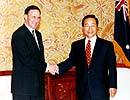
As Prime Minister, Mr Keating turned Australia's focus away from our traditional ties with Europe and the United States and towards Asia, our nearest neighbours and the fastest growing region in the world.
On 13 March 1993, Mr Keating led the Federal Government to an historic fifth term of Government, and his second as Prime Minister. The Government was returned to office with an increased majority in the House of Representatives, and a swing of around 6 per cent. Mr Keating proclaimed the election a victory for the true believers - all those people who had imagination and faith and believed in a compassionate, forward thinking and visionary Australia.
His achievements during this term included the introduction of major reforms designed to address the issue of long-term unemployment, historic legislation to provide land rights to Australia's indigenous people, proposals for constitutional reform to make Australia a republic by the year 2000, the introduction of a national superannuation scheme, and the further development of Australia's relations with the Asia-Pacific, including an active role in APEC's development and its free trade commitment, and the conclusion of an historic Security Agreement with Indonesia.
He was awarded an honorary degree of Doctor of Laws for his work in the Asia-Pacific region by Keio University in Tokyo in May 1995.
On 2 March 1996 the Labor Party was defeated in the Federal Election. Mr Keating relinquished the leadership of the parliamentary party and resigned from Parliament on 23 April 1996.
In May 1996, he was appointed as a Visiting Professor at the University of New South Wales with a special relationship with the University's Asia-Australia Institute. He has continued to take a close interest in the national issues with which he was associated in public life.
Mr Keating married his wife Annita in 1975 and they have four children: Patrick, Caroline, Katherine and Alexandra.
Mr Keating's interests include classical music and fine arts.
May 1996
